If a fire inspector, insurer or housing officer asked to see your fire alarm records tomorrow, could you show them? A fire alarm logbook, together with up-to-date servicing certificates, is the simplest way to prove that your system has been tested, serviced and looked after.
This guide explains what a fire alarm logbook is, what you should record in it, what a servicing certificate should show, and which records businesses, landlords and property managers in Worcestershire and across the UK should keep on file.
Quick answer: A fire alarm logbook is a record, kept on site, of everything that happens to your fire alarm system: weekly tests, faults, false alarms, servicing visits, repairs and changes. Alongside it, keep the servicing certificate or report issued after each professional visit, commonly every six months for non-domestic systems under BS 5839-1. Together they show that the system is being maintained as the Regulatory Reform (Fire Safety) Order 2005 expects.
What Is a Fire Alarm Logbook?
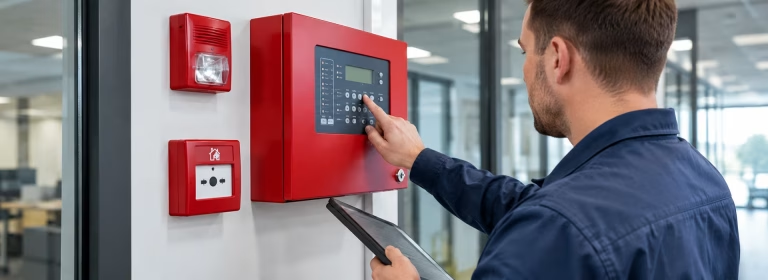
A fire alarm logbook (sometimes called a fire safety logbook or fire alarm testing log) is a running record of your system’s history. It is usually a bound book kept near the fire alarm control panel, though a well-managed digital record works too.
It answers simple questions that matter during an inspection, an insurance claim or a change of contractor:
- When was the system last tested, and by whom?
- Has it developed any faults, and were they fixed?
- When was it last professionally serviced?
- Have there been false alarms, and what caused them?
- Has the building or the system changed?
BS 5839-1, the British Standard for fire detection and alarm systems in non-domestic premises, recommends that a logbook is kept for the system.
Logbook vs servicing certificate: what is the difference?
They do different jobs, and you need both.
- The logbook is your day-to-day record, completed by the responsible person or nominated staff.
- The servicing certificate or report is issued by the competent engineer after each professional visit and records what was inspected, tested and found.
Who is the responsible person?
Under the Regulatory Reform (Fire Safety) Order 2005, the responsible person is usually the employer, the occupier or the owner who has control of the premises. In apartment blocks and managed buildings, the landlord or managing agent is normally responsible for the communal areas, including the fire alarm. If more than one party shares responsibility, they must co-operate and share information.
Is a Fire Alarm Logbook a Legal Requirement?
The honest answer is that it depends how you look at it.
The Fire Safety Order requires the responsible person to make sure fire safety equipment is maintained in an efficient state, in efficient working order and in good repair. It does not set out a specific logbook format. However, BS 5839-1 recommends keeping one, and in practice records are how you demonstrate that maintenance is actually happening.
Fire and rescue authority inspectors, insurers, housing teams and landlords’ agents commonly ask to see them. If you cannot produce records, it is difficult to show that testing and servicing took place, even if it did. Recording your fire risk assessment is a separate duty, so check the current GOV.UK guidance for your type of premises.
In short: treat a logbook and servicing certificates as the expected evidence, not an optional extra.
What Should You Record in a Fire Alarm Logbook?
Use the table below as a starting point. Your system documentation and your fire alarm engineer can tell you if your premises need anything extra.
| What to record | How often | What to write down |
|---|---|---|
| Control panel check | Daily, or as your system guidance says | Date, who checked, whether the panel shows normal or any fault indication |
| Weekly alarm test | Weekly | Date and time, which manual call point was tested, who tested it, whether the sounders operated, any problems |
| Faults | Whenever they occur | Date and time, description of the fault, who reported it, action taken, date cleared |
| Unwanted (false) alarms | Whenever they occur | Date and time, which device activated, likely cause, action taken to prevent a repeat |
| Real fire alarm activations | Whenever they occur | Date and time, cause, whether the fire service was called, who reset the system |
| Professional servicing | Approximately every six months | Date, engineer and company, certificate reference, defects found, remedial work recommended |
| Repairs, upgrades and changes | Whenever they happen | What changed, who did the work, date, any updated plans or documentation |
| Building changes | Whenever they happen | Refurbishments, new partitions or change of use, and the date you asked an engineer to review detector coverage |
| System out of service | Whenever it happens | Date and time, reason, temporary fire safety measures put in place, who was told, when it was restored |
| Training and key contacts | When it changes | Who is trained to carry out checks, plus contractor and out-of-hours contact numbers |
Tips for keeping a useful logbook
- Test a different call point each week so that every call point gets tested over time, and note which one in the log.
- Sign and date every entry. Unsigned entries carry little weight.
- Name one person and a deputy to carry out the weekly test, so it never depends on one person being in.
- Keep it where it can be found. If a digital record is used, make sure it is backed up and that someone can access it when you are not there.
- Record faults and false alarms, not just clean tests. Patterns in unwanted alarms often point to the cause.
What Is a Fire Alarm Servicing Certificate?
After a professional service, the engineer should issue a certificate or service report. Think of it as the engineer’s statement of what was done and what was found. Keep every one.
What a good fire alarm certificate should show
- The site name and address, and the type of system and control panel
- The date of the visit, and the engineer and company who carried it out
- The standard the work was carried out to, such as BS 5839-1
- Which parts of the system were inspected and tested. On many systems a proportion of devices is tested at each visit so that every device is covered across the year, so ask your engineer how this works for your site
- Any defects, variations from the standard or recommended remedial work, with a clear indication of what needs attention
- A recommendation for the next service
- The engineer’s signature and the date
It is also worth checking that the company holds relevant third-party certification, such as BAFE SP203-1 for fire detection and alarm systems.
A servicing certificate is useful evidence of maintenance activity, but it does not by itself prove that every aspect of your building’s fire safety arrangements is compliant. That is what your fire risk assessment is for.
How often should this visit happen? For many non-domestic systems the recommended interval is six months. Read our guide on how often a commercial fire alarm should be serviced for the detail.
Fire Alarm Records for Landlords, HMOs and Property Managers
If you manage apartment blocks, converted buildings or houses in multiple occupation, good records matter even more, because you may be answerable to residents, councils and insurers as well as inspectors.
- Keep records per building. Each block needs its own logbook and its own set of certificates.
- Know who is responsible. Agree in writing whether the landlord, managing agent or an individual building manager carries out weekly tests and arranges servicing.
- Expect requests from councils. Local authorities may ask licensed HMO landlords for a recent servicing certificate confirming the alarm has been tested and maintained to the relevant standard. Smaller domestic-style systems may be covered by a different standard, so check what applies to your property.
- Hand records over properly. When a managing agent changes, the logbook and certificates should pass to the new agent.
One of our property clients, who manages a converted apartment building, told us they valued how quickly their compliance certificates were issued after testing. Paperwork is part of the service, not an afterthought. If you look after multiple buildings, see our fire alarm services for property managers, managing agents and landlords.
Common Fire Alarm Record-Keeping Mistakes
- No named person responsible for the weekly test
- Testing the same call point every week
- Not recording false alarms, so repeat causes are never spotted
- Servicing visits that slip well beyond the six-monthly schedule
- Faults written down but never followed up
- Certificates held only by the contractor and lost when the contract changes
- A logbook that is not updated after building work or alterations
- A logbook that nobody on site can find
No Logbook or Missing Certificates? What to Do
Many businesses and landlords find, usually at the worst moment, that they have no logbook or that certificates are missing. Here is a practical way to put it right.
- Start a logbook today. Use the table above and write the start date at the top. A clear record from now is far better than none.
- Ask for copies of past service reports. Your current or previous fire alarm company should be able to supply copies of the reports they issued.
- Name a responsible person and a deputy, and fix a regular day and time for the weekly test.
- Have the system inspected. A competent engineer can check its condition and tell you what needs attention. If you are unhappy with your current provider, we can assess the existing system and take over servicing where suitable.
- Book your next service and put it in the diary, so the six-monthly cycle is not missed.
Do not try to recreate missing history by backdating entries. If there is a gap in your records, note it honestly and carry on from today.
How Long Should You Keep Fire Alarm Records?
There is no single retention period that suits every building and every type of record, so ask your fire risk assessor and your insurer what they expect. As a practical approach, many responsible persons keep several years of fire alarm history, and always keep the most recent servicing certificates readily available on site.
Frequently Asked Questions
Do I need a fire alarm logbook?
The Fire Safety Order does not set out a fixed logbook format, but BS 5839-1 recommends keeping one, and in practice inspectors, insurers and housing teams expect to see records of testing and servicing. Keeping a logbook is the simplest way to show that your system is being maintained.
What is the difference between a fire alarm logbook and a servicing certificate?
The logbook is your own running record of tests, faults, false alarms and changes. The servicing certificate is issued by the engineer after each professional visit and records what was inspected, tested and found. You should keep both.
Who should keep the fire alarm logbook?
The responsible person is accountable for it, although a nominated person on site usually completes it. Keep it somewhere accessible, typically near the fire alarm control panel.
How often must a fire alarm be tested and serviced?
A manual call point is commonly tested weekly by the responsible person or nominated staff, and many non-domestic systems are professionally serviced about every six months. The exact schedule depends on your system, premises and risk assessment.
Can I keep a digital fire alarm logbook?
Yes, provided entries are dated and attributable, the record is backed up and someone can access it when needed. Many sites also keep a paper copy next to the control panel.
What if my previous fire alarm company never gave me certificates?
Ask them for copies first. If they cannot supply them, start your logbook from today, note the gap and arrange an inspection and service with a competent contractor so that you have a current certificate on file.
Do landlords of flats need to keep fire alarm records?
If you are responsible for communal areas, yes, you should keep testing and servicing records for each building. Some councils also ask licensed HMO landlords for servicing certificates, so check any licence conditions that apply to your property.
Arrange Fire Alarm Servicing and Paperwork in Worcestershire
Fire & Theft Protection UK is a BAFE SP203-1 certified fire alarm specialist providing planned servicing, fault finding, maintenance contracts and system takeovers for businesses, landlords and property managers across Worcester, Redditch, Bromsgrove, Kidderminster, Droitwich, Malvern and surrounding areas. After each service, we provide service documentation and reports for your records.
If you are not sure your records would stand up to an inspection, or you want to move to a new maintenance provider, we can assess your existing system and talk you through the next steps.
Call: 0800 0016 482 · Email: info@fireandtheftprotectionuk.co.uk
Want to know more first? Explore our fire alarm systems and installation or contact our team.
Further Reading and Fire Safety Guidance
- GOV.UK: Fire safety risk assessment for offices and shops
- GOV.UK: Workplace fire safety, your responsibilities
- Fire Industry Association: Maintaining your fire alarm system
Note: This article provides general information about fire alarm record keeping in the UK and is not a substitute for a premises-specific fire risk assessment or competent technical advice. Always check the current applicable standards and requirements for your system and location.