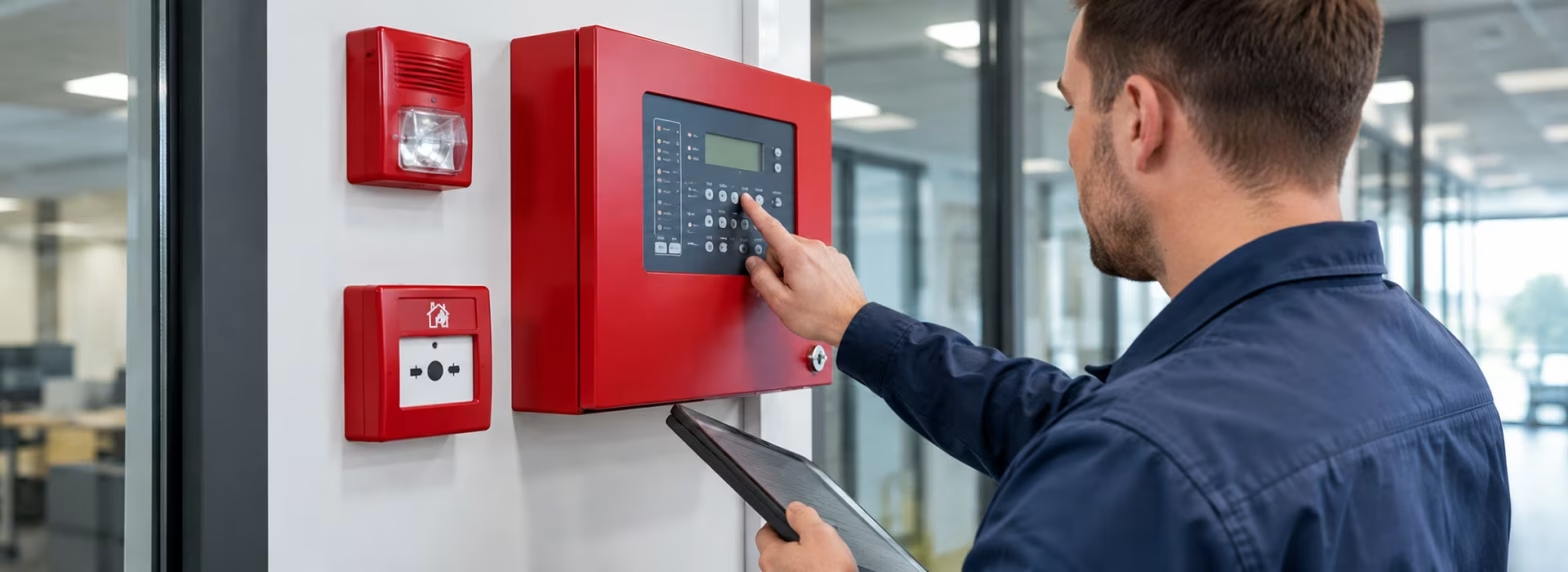
Commercial fire alarms should generally be professionally serviced every six months, in line with the recommendations of BS 5839-1 for relevant non-domestic fire detection and alarm systems. The appropriate maintenance schedule depends on the system, building, risk assessment and applicable requirements. Under BS 5839-1:2025, the recommended service interval is six months, with individual visits taking place within the permitted five-to-seven-month window.
However, professional servicing is only one part of effective fire alarm maintenance. Businesses must also arrange appropriate routine checks, investigate faults promptly and keep suitable maintenance records. Understanding how often a commercial fire alarm needs servicing helps protect occupants, maintain system reliability and support your fire safety responsibilities.
In this guide, we explain UK fire alarm servicing recommendations, routine testing requirements, what a professional service includes and how to arrange maintenance for your commercial premises.
How Often Should a Commercial Fire Alarm Be Serviced in the UK?
For many commercial properties, the recommended interval for professional fire alarm servicing is every six months. This helps ensure that the system is inspected, tested and maintained by a competent person at appropriate intervals.
The UK government’s fire safety guidance for offices and shops recommends six-monthly testing and maintenance of fire detection and warning systems by a competent person. The relevant British Standard, BS 5839-1:2025, provides recommendations for fire detection and alarm systems in non-domestic premises.
The servicing schedule should take account of the installed system, the environment in which it operates, the building’s fire risk assessment and the manufacturer’s instructions. Some premises may require additional attention or more frequent maintenance.
Professional servicing should also be supported by routine checks carried out by the responsible person or a nominated member of staff.
Fire Alarm Testing and Servicing Schedule
Routine user checks and professional servicing have different purposes. The following table provides a general overview for commercial premises. Always follow your system documentation, applicable guidance and the advice of a competent fire alarm professional.
| Frequency | Typical activity | Responsible person |
|---|---|---|
| Daily or as specified by the system guidance | Check the control panel for fault indicators and confirm that the system appears operational. | Responsible person or nominated staff |
| Weekly | Test the fire alarm using a manual call point in accordance with the system instructions and record the result. | Responsible person or nominated staff |
| Approximately every six months | Arrange professional inspection, testing and servicing in accordance with the applicable standard and maintenance plan. | Competent fire alarm service provider |
| Throughout the year | Report faults promptly, maintain records and arrange any additional inspections or remedial work required. | Responsible person and competent contractors |
The exact checks and intervals may vary according to the system and premises. For further guidance, consult the government’s fire safety risk assessment guidance and the Fire Industry Association’s guidance on maintaining fire alarm systems.
What Do UK Fire Safety Regulations Say About Fire Alarm Servicing?
The Regulatory Reform (Fire Safety) Order 2005 places duties on the responsible person in relevant premises in England and Wales. These duties include ensuring that fire safety equipment and facilities are maintained in an efficient state, in efficient working order and in good repair.
For businesses and property managers, this means that installing a fire alarm is not enough. Appropriate arrangements must be in place to maintain the system, identify defects and ensure that necessary repairs are carried out.
BS 5839-1 is the recognised British Standard covering the design, installation, commissioning and maintenance of fire detection and fire alarm systems in non-domestic premises. Its recommendations help responsible persons and competent contractors establish suitable maintenance arrangements.
It is important to distinguish between a legal duty to maintain fire safety equipment and a servicing interval recommended by a technical standard. Six-monthly professional servicing is a common recommendation, but the appropriate arrangements depend on the applicable requirements, the system and the premises.
You can read the official UK government fire safety guidance for further information about the responsibilities of employers, managers, occupiers and building owners.
What Is Included in a Professional Commercial Fire Alarm Service?
A professional commercial fire alarm service involves inspecting and testing relevant parts of the system to check their condition and operation. The exact work depends on the installation, the equipment and the applicable maintenance requirements.
A planned service may include the following activities:
- Fire alarm control panel inspection: Checking the control panel for fault indications, warnings and other issues.
- Smoke and heat detector testing: Testing suitable detection devices using appropriate methods.
- Manual call point testing: Confirming that relevant call points activate the alarm system correctly.
- Sounder and warning device checks: Testing audible and visual warning devices where applicable.
- Battery and power supply checks: Inspecting batteries and associated power supplies for signs of deterioration or faults.
- System operation checks: Checking relevant equipment and functions in accordance with the system requirements.
- Fault history review: Reviewing available system records, previous faults and unwanted alarm activations.
- Maintenance documentation: Recording findings, identifying defects and recommending necessary remedial work.
Following the service, the responsible person should retain the service report and arrange any necessary repairs. A service report is useful evidence of maintenance activity, but it does not automatically establish that every aspect of a building’s fire safety arrangements is compliant.
Learn more about our commercial fire alarm servicing and maintenance services.
Why Is Regular Fire Alarm Servicing Important?
Regular fire alarm servicing helps businesses identify faults, maintain reliable detection and warning equipment, and manage their ongoing fire safety responsibilities.
1. Helps Protect Employees, Customers and Visitors
A properly maintained fire alarm can help detect a fire and warn occupants so that they can respond and evacuate promptly. This is particularly important in buildings where visitors may be unfamiliar with escape routes or where some occupants may need assistance.
2. Identifies Faults Before They Become More Serious
Fire alarm detectors, batteries, wiring and other components can deteriorate over time. Routine checks and professional servicing can help identify problems early so that appropriate corrective action can be arranged.
3. Helps Reduce Unwanted Fire Alarm Activations
Repeated unwanted alarms can disrupt business operations, interrupt staff and customers, and lead to unnecessary evacuations. Appropriate inspection and maintenance can help identify potential causes and support efforts to reduce unwanted activations.
The Fire Industry Association’s maintenance guidance explains the importance of regular servicing and competent testing in helping to limit false alarms.
4. Supports Effective Fire Safety Management
Service reports, routine test records and fault logs help the responsible person monitor the condition of the fire alarm system and manage ongoing maintenance. Keeping accurate records also helps demonstrate what inspections and corrective actions have been completed.
5. Helps Identify Changes to Building Requirements
Refurbishments, new partitions, changes in occupancy or changes to the use of a building can affect the suitability of an existing fire alarm system. Maintenance visits can help identify issues that may need further investigation or an assessment of the system’s coverage.
Do Different Commercial Buildings Need Different Servicing Schedules?
Six-monthly professional servicing is a common starting point for many non-domestic fire alarm systems, but the appropriate maintenance arrangements depend on the property and its fire safety requirements.
Offices and Retail Premises
Offices and shops need suitable routine testing, professional servicing and a process for reporting faults. Changes to layouts, partitions or occupied areas should also be considered when reviewing the fire alarm system.
Warehouses and Industrial Buildings
Dust, temperature variations, storage arrangements and operational conditions can affect fire detection equipment. The maintenance plan should reflect the environment and the type of system installed.
Schools and Educational Buildings
Servicing arrangements should account for occupancy patterns, access to equipment and the need to maintain effective warning arrangements during school activities and other building use.
Hotels and Care Homes
Sleeping accommodation and premises where occupants may need assistance during evacuation require particular attention to their fire safety arrangements. The servicing schedule should be determined by the applicable requirements, system design and risk assessment.
Apartment Blocks and Managed Properties
Property managers and landlords should understand which fire alarm systems serve communal areas and who is responsible for their maintenance. Appropriate arrangements should include scheduled servicing, fault reporting, records and coordination with relevant parties.
For help managing systems across multiple buildings, explore our fire alarm services for property managers, managing agents and landlords.
What Happens If a Commercial Fire Alarm Is Not Serviced?
Missing planned maintenance can allow faults to remain undetected and reduce confidence in the operation of a fire alarm system. Potential consequences include:
- Detectors or warning devices that do not operate correctly.
- Unresolved system faults or deteriorating batteries.
- Repeated unwanted alarm activations and business disruption.
- Incomplete service records and difficulty tracking maintenance work.
- Difficulty demonstrating that suitable fire safety maintenance arrangements are in place.
- Increased risk to occupants if the system does not perform as intended during an emergency.
If a fire alarm develops a fault, the responsible person should arrange prompt investigation and appropriate corrective action. Where a fault significantly affects the system’s operation, competent advice should be obtained promptly and suitable temporary fire safety measures considered.
When Should You Arrange a Fire Alarm Service?
Do not wait until your next scheduled maintenance visit if your fire alarm system shows signs of a problem. Contact a competent service provider if you notice any of the following:
- A persistent fault indication on the fire alarm control panel.
- Repeated unwanted alarm activations.
- Damaged detectors, manual call points or sounders.
- Battery or power supply warnings.
- Missing service records or an overdue maintenance visit.
- Building alterations that could affect detector coverage or system operation.
Prompt investigation helps identify the cause of the problem and determine the appropriate corrective action. You can contact Fire & Theft Protection UK for fire alarm fault finding, servicing and maintenance.
Frequently Asked Questions About Commercial Fire Alarm Servicing
How often should a commercial fire alarm be serviced?
Many commercial fire alarm systems are professionally serviced approximately every six months, in line with BS 5839-1 recommendations where applicable. The correct schedule depends on the system, premises, risk assessment and relevant requirements.
Is annual fire alarm servicing enough?
Annual servicing alone would generally fall short of the six-monthly servicing recommendation in BS 5839-1 for relevant non-domestic systems. Check the applicable standard, system documentation and maintenance requirements for your premises.
Is six-monthly fire alarm servicing a legal requirement?
Fire safety legislation requires relevant fire safety equipment to be properly maintained, but the six-month interval comes from recommendations in the applicable technical standard rather than a single statutory interval for every building. The responsible person must establish suitable maintenance arrangements for their premises.
Who can service a commercial fire alarm?
Commercial fire alarm servicing should be carried out by a competent person with appropriate knowledge and experience of the installed system. When selecting a contractor, check their competence, relevant third-party certification where applicable, service documentation and ability to maintain your particular installation.
Does weekly fire alarm testing replace professional servicing?
No. Weekly testing is a routine check carried out by the responsible person or a nominated member of staff. Professional servicing involves more extensive inspection and testing by a competent service provider. Both are important parts of an effective maintenance programme.
What records should be kept after a fire alarm service?
Keep service reports, inspection findings, records of faults and remedial work, routine test records and details of unwanted alarm activations. These records help the responsible person monitor the system and manage ongoing maintenance.
Can a fire alarm servicing company maintain a system installed by another provider?
Yes, a competent contractor may be able to take over maintenance of an existing system following an appropriate assessment of the installation, its condition, available records and any remedial work required. Find out more about our fire alarm system takeovers and maintenance services.
Arrange Commercial Fire Alarm Servicing with Fire & Theft Protection UK
Regular fire alarm servicing is an important part of protecting people, property and business operations. A suitable maintenance schedule, routine testing, accurate records and prompt attention to faults help support reliable fire detection and warning arrangements.
Fire & Theft Protection UK provides professional fire alarm servicing and maintenance for commercial, residential and managed premises across Worcestershire and surrounding areas. As a BAFE SP203-1 certified company, we provide planned servicing, fault finding, maintenance contracts and system takeovers, subject to the requirements of the installation.
Whether you need a routine service, support with a faulty system or a new maintenance provider, our team can help you understand the next steps.
Call: 0800 0016 482
Email: info@fireandtheftprotectionuk.co.uk
Need help with your existing system? Explore our fire alarm services or learn about fire alarm maintenance for property managers.
Further Reading and Fire Safety Guidance
- GOV.UK: Fire Safety Risk Assessment for Offices and Shops
- Fire Industry Association: Maintaining Your Fire Alarm System
- C-TEC: Guide to Changes in BS 5839-1:2025
- GOV.UK: Workplace Fire Safety Responsibilities
Note: This article provides general information about fire alarm maintenance in the UK and is not a substitute for a premises-specific fire risk assessment or competent technical advice. Always check the current applicable standards and requirements for your system and location.